Security awareness for campus — and a real platform for teaching it.
Universities, polytechnics, and colleges use Trawl two ways: to run security awareness for their own staff, the same as any organization — and to give cybersecurity and computing instructors an actual platform to teach with, not just slides.

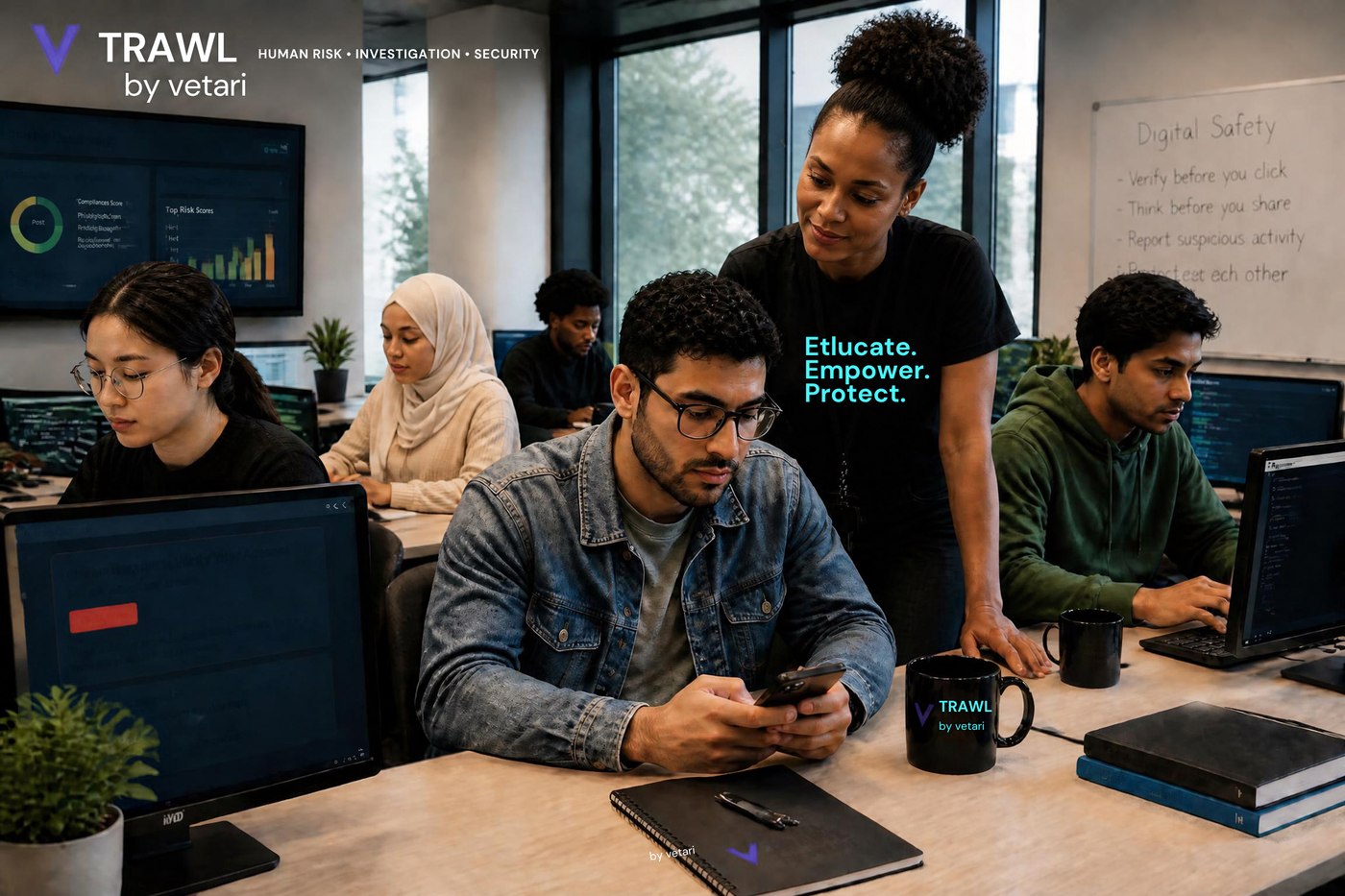
Security awareness across your institution.
Faculty, administrative staff, and research teams face the same phishing and social-engineering risks as any organization — often across sprawling, decentralized departments. Trawl pairs phishing simulation, Investigation Lab training, and role-based follow-up so staff can spot suspicious requests before student data, research funding, or institutional accounts are put at risk.
Decentralized departments widen exposure
Faculties, admin offices, and research groups often run with very different technical maturity and IT support.
Student and research data raise the stakes
Admissions records, grades, and research data are attractive, sensitive targets that don't belong in the wrong inbox.
Non-technical staff need practical training
Faculty and administrative staff need training that's realistic and quick — not a generic corporate compliance module.
- Fake HR & payroll messages
Impersonated payroll or benefits emails target faculty and staff with credential-harvesting links. - Fake IT support requests
Attackers pose as campus IT to harvest login credentials or push malicious software. - Research & grant fraud
Fake funding bodies, vendors, or collaborators target research staff with urgent requests. - Student-data impersonation
Attackers pose as students or parents to request record changes or sensitive information.
The Trawl phishing simulator and security awareness training run the same way here as anywhere else — scheduled campaigns, automatic remediation through Investigation Lab, and a Human Risk Dashboard your IT or security team can actually act on.
A real platform for teaching security awareness.
For cybersecurity and computing instructors, Trawl isn't just something to describe in a lecture — it's something students actually run. The instructor becomes the class Admin: invite a class of students, choose exactly what they run, and see what each student actually did.
Set up your class
The instructor becomes Admin and invites a class of students by email or invite code.
Choose what students run
Assign specific phishing simulations, Investigation Lab cases, or courses — the instructor controls exactly what's in scope.
Students learn hands-on
Real simulated phishing cases and investigations, not just slides — students practice the skill, not just read about it.
Instructor sees the results
A class dashboard shows what each student ran, completed, and got right or wrong — per student, per assignment.
Built for the next generation of SAT specialists.
Reading about phishing and social engineering only goes so far. Trawl gives computing and cybersecurity students a real platform to practice on — the same kind of tool they'll use professionally if they go on to run security awareness programs themselves.
- Cybersecurity and computing instructors teaching phishing, social engineering, or security awareness concepts
- Students working toward hands-on skill as a future security awareness training (SAT) specialist
- Computing departments that want a practical module alongside the theory
- Instructors who want to see individual student engagement, not just a class average
Bring Trawl into your classroom.
Set up a class, invite your students, and control exactly what they run — with full visibility into what each student did.
Request a demo View pricingEducation & EdTech FAQ.
Common questions from universities, polytechnics, and colleges.
Yes — the two run independently. Campus Awareness covers faculty and administrative staff, while Instructor & Classroom gives computing or cybersecurity instructors their own class environment for students.
The instructor is the Admin for their class. They invite students, and choose exactly which simulations, Investigation Lab cases, or courses are assigned — students only see what the instructor makes available.
A class dashboard shows completion, results, and skill gaps for each student and assignment — not just a class-wide average.
Real simulated phishing scenarios and Investigation Lab cases — examining senders, domains, links, and headers — the same practical skills used in a professional security awareness program.
Yes — students get hands-on practice with the same kind of platform they'd use professionally running a security awareness training program, not just theory.
Yes — Campus Awareness and Instructor & Classroom both work the same way for universities, polytechnics, and colleges.